- Sunrise Stat
- Posts
- 🌅 You May Have a “Yawning Signature”
🌅 You May Have a “Yawning Signature”

Sunrise Stat
March 18, 2026
Uncover the power of a single statistic: Sign up for Sunrise Stat to find your intellectual clarity.
SOURCE
WHAT TO KNOW
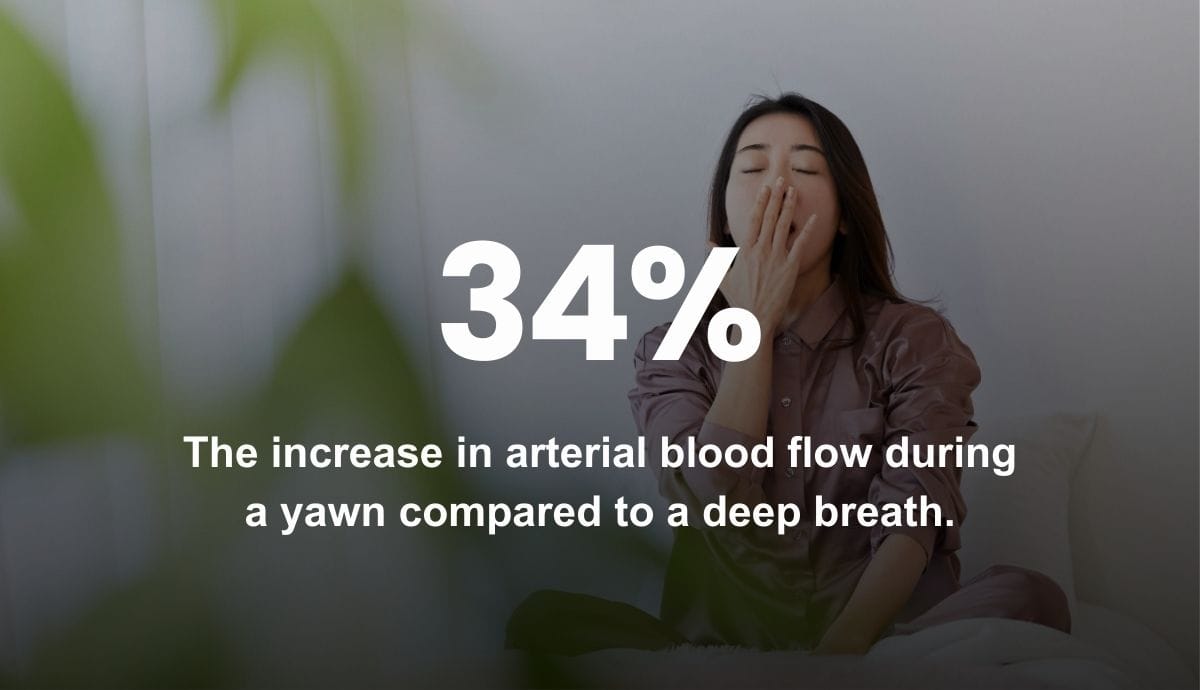
A recent study by researchers at Neuroscience Research Australia compared brain MRI scans of 22 study participants while they breathed normally, took a deep breath, yawned, and stifled a yawn, expecting to discover similarities between deep breathing and yawning as the acts require similar physical actions. Instead, the scans showed yawning pushes spinal fluid away from the brain while deep breathing brings it in, surprising the researchers. The team also found yawning increased blood flow in the carotid arteries by 34% compared with deep breathing, supplying more oxygen-rich blood to the brain. The study was released as a preprint, meaning it has yet to be peer-reviewed.
WHY IT MATTERS
While the exact reasons why we yawn aren’t yet clear, the work suggests yawning is a distinct biological act that reorients the flow of fluids out of the brain. Popular theories as to why we yawn include bringing oxygen to the lungs, improving blood circulation, and the role spinal fluid plays in cooling the brain and clearing it of metabolic waste. Interestingly, the present study also found all 22 participants had slightly different patterns of tongue movement during yawns, suggesting humans could have unique “yawning signatures,” similar to fingerprints.
CONNECT THE DOTS
Yawning has been documented within all classes of vertebrates—mammals, birds, reptiles, amphibians, and fish—and because it’s so ubiquitous, experts believe it’s an ancient function that likely arose with the evolution of the earliest jawed fishes some 400 million years ago. Research also shows that, just like humans, several animal species experience yawn contagion, including chimpanzees, parrots, domesticated dogs, and even certain fish.