- Sunrise Stat
- Posts
- 🌅 Rewriting the Origins of Complex Life on Earth
🌅 Rewriting the Origins of Complex Life on Earth

Sunrise Stat
April 15, 2026
Xiaodong Wang
Uncover the power of a single statistic: Sign up for Sunrise Stat to find your intellectual clarity.
SOURCE
WHAT TO KNOW
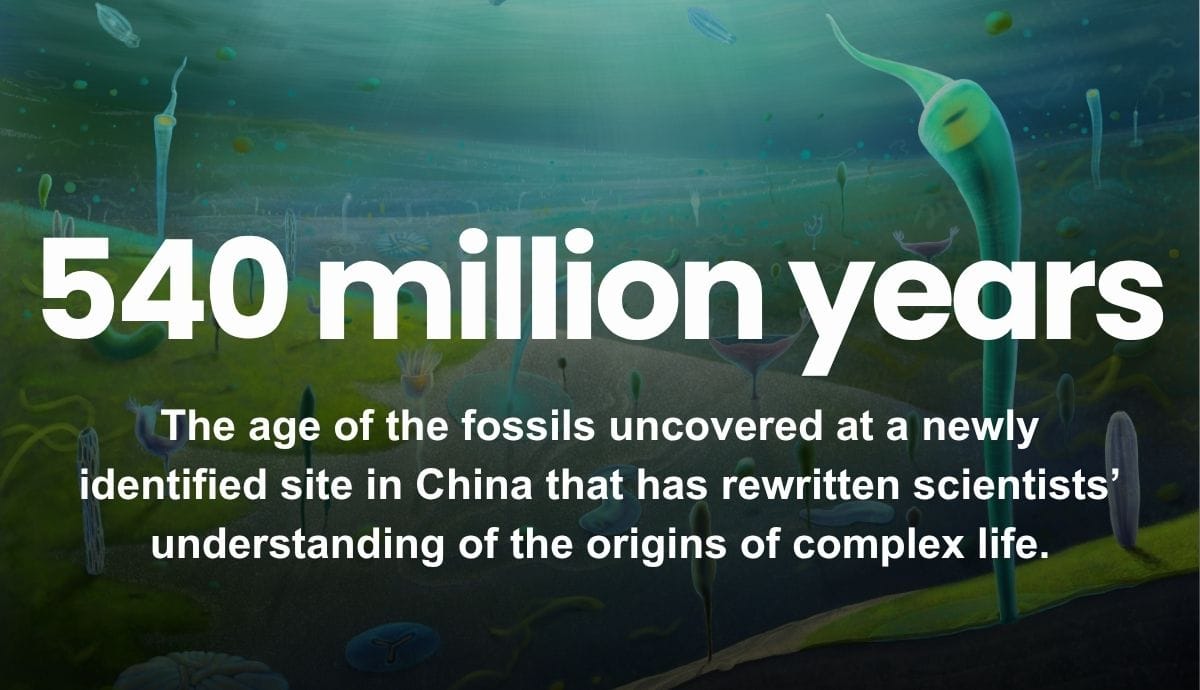
A newly identified fossil site in southwest China has upended scientists’ understanding of the origins of complex life on Earth, revealing many key animal groups evolved millions of years earlier than previously believed. The discovery comes from the Jiangchuan Biota, where researchers uncovered more than 700 fossils dating from 550 million to 539 million years ago, during the late Ediacaran period, including previously unknown species and animals once thought to first appear later during the Cambrian period.
WHY IT MATTERS
Until now, scientists believed the rapid rise of diverse and complex life on Earth happened around 535 million years ago, during an event known as the Cambrian explosion. The present study challenges that timeline and fills in key evolutionary gaps, suggesting the shift from simple organisms to advanced life happened at least 4 million years earlier than previously believed. Among the fossils uncovered by researchers are specimens believed to be the oldest known relatives of deuterostomes, the broader group that today includes vertebrates such as humans and fish, as well as the ancestors of modern starfish and their closest relatives, acorn worms.
CONNECT THE DOTS
Not far from Jiangchuan Biota is the Chengjiang Fossil Site, where researchers recently discovered the earliest recorded creatures with spines—inch-long noodle-like jawless fish that lived half a billion years ago known as myllokunmingids—also had two sets of eyes. Put differently, the finding suggests humans’ earliest known vertebrate ancestor was an inch-long noodle with four eyes.