- Sunrise Stat
- Posts
- 🌅 The “Queen of Icebergs” Is Now a Blob of Mush
🌅 The “Queen of Icebergs” Is Now a Blob of Mush

Sunrise Stat
February 19, 2026
NASA
Uncover the power of a single statistic: Sign up for Sunrise Stat to find your intellectual clarity.
SOURCE
WHAT TO KNOW
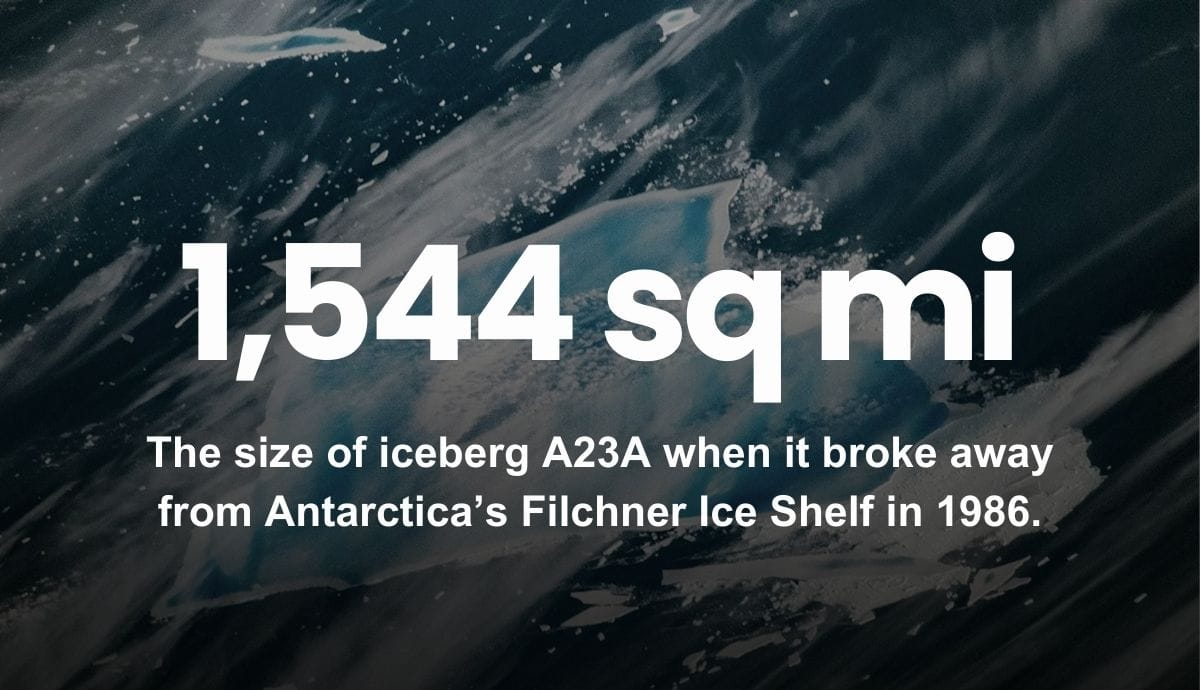
Iceberg A23A, one of the largest and oldest icebergs ever tracked by scientists, is in the final throes of its 40-year life, as new data from the U.S. National Ice Center puts the area of the former megaberg at just 217 square miles, down some 86% from the 1,544 square miles it covered when it broke away from Antarctica’s Filchner Ice Shelf in the summer of 1986. Experts say satellite images captured in December 2025 suggest A23A has transformed into a massive blob of “blue mush” as it approaches complete disintegration following a dizzying journey in the South Atlantic.
WHY IT MATTERS
A23A was nearly twice the size of Rhode Island when it detached from the Filchner Ice Shelf 40 years ago, quickly becoming trapped in place as its submerged bottom caught the seafloor. The close proximity to its parent ice sheet meant A23A—dubbed the “queen of icebergs”—didn’t lose much size over the next four decades, repeatedly capturing the title of the world’s largest iceberg (it was sometimes overtaken by larger but shorter-lived icebergs and regained the title after those broke apart). It most recently held the title from June 2023 to September 2025.
CONNECT THE DOTS
A recent study by researchers at ETH Zürich in Switzerland analyzed how many of the world’s glaciers will survive to the year 2100 under different global warming scenarios, finding the world can expect to lose around half of its 200,000 glaciers under even the most ambitious goals set by the 2015 Paris Agreement (to limit warming to 1.5 degrees Celsius above pre-industrial levels). Under the worst case scenario (+4 degrees Celsius of warming), the world can expect to lose around 90% of its glaciers by the end of the century.