- Sunrise Stat
- Posts
- 🌅 Wild Chimpanzees Are Locked In a Civil War-Like Split
🌅 Wild Chimpanzees Are Locked In a Civil War-Like Split

Sunrise Stat
April 14, 2026
Uncover the power of a single statistic: Sign up for Sunrise Stat to find your intellectual clarity.
SOURCE
WHAT TO KNOW
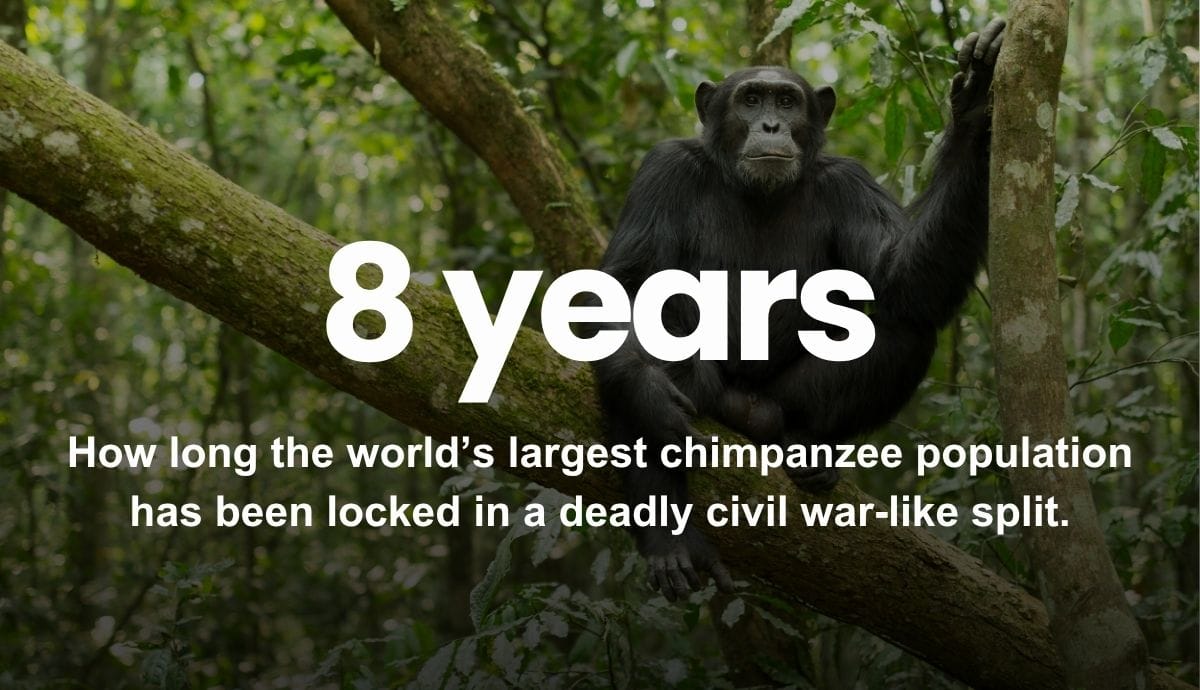
The Ngogo chimpanzees of Kibale National Park in Uganda, the world’s largest known population of wild chimpanzees, has permanently split into two factions that are now locked in a deadly dynamic the researchers say parallels human civil war (however, the authors caution against actually calling it a “civil war” as warfare has a distinct human meaning and context). An international team of scientists described the split and subsequent years of violence in a new study drawing on three decades of ongoing observations of the once-harmonious population of 150-200 chimpanzees. The authors say it's the first-known case of permanent fission documented among wild chimpanzees.
WHY IT MATTERS
From 1998 to 2014, individual chimpanzees in the Ngogo population moved freely between flexible subgroups or clusters, maintaining social ties across the community in a fission-fusion dynamic typical of the species. However, in 2015, the researchers noticed individuals in the Western and Central clusters began avoiding each other, a shift that coincided with a change in the population’s male dominance hierarchy and the deaths of the last individuals that straddled both groups, which likely severed social bonds. By 2018, the split was complete, resulting in distinct Western and Central groups with separate territories. Since then, the Western group has launched a series of attacks on the Central group, killing at least 17 infants and 7 adult males from 2018 to 2024.
CONNECT THE DOTS
The authors say their findings challenge the hypothesis that human war is primarily driven by cultural markers like ethnic, religious, or political differences. “If relational dynamics alone can drive polarization and lethal conflict in chimps without language, ethnicity or ideology, then in humans, those cultural markers might be secondary to something more basic,” said the study’s lead author. “If that’s true, then we may have the potential to reduce societal conflicts in our personal lives, and that gives me hope.”