- Sunrise Stat
- Posts
- 🌅 Launching a Landmark Time-Lapse of the Universe
🌅 Launching a Landmark Time-Lapse of the Universe

Sunrise Stat
March 03, 2026
Uncover the power of a single statistic: Sign up for Sunrise Stat to find your intellectual clarity.
SOURCE
WHAT TO KNOW
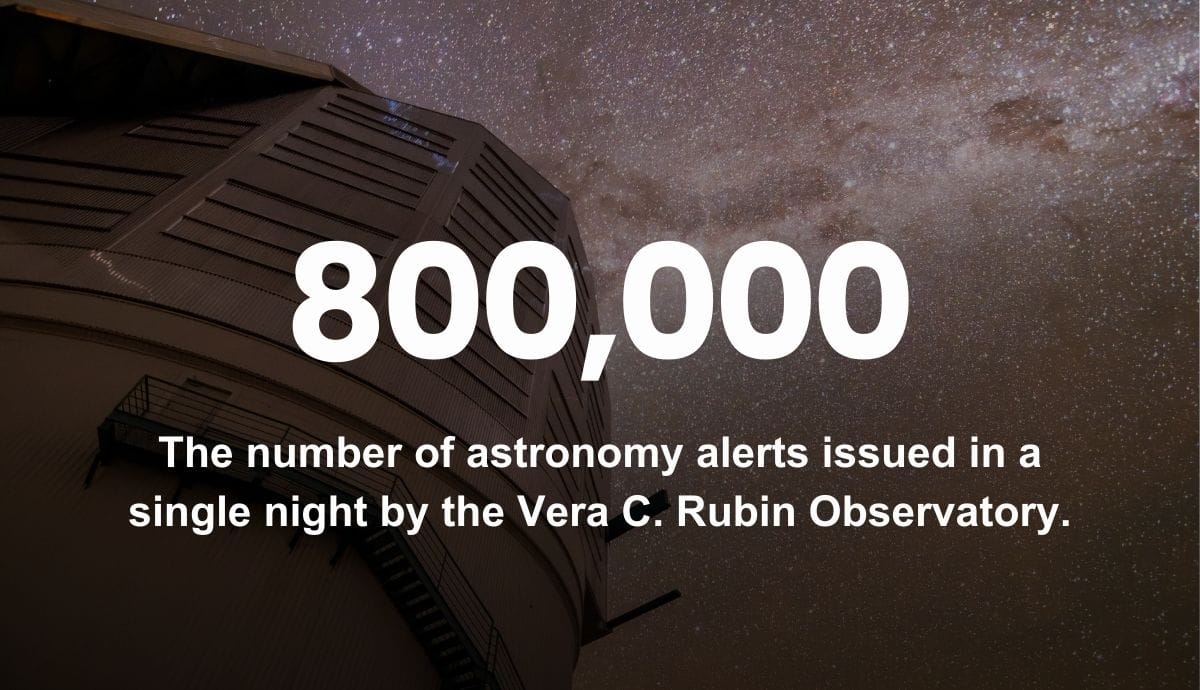
The newly commissioned Vera C. Rubin Observatory in Chile—jointly funded by the U.S. National Science Foundation and the U.S. Department of Energy's Office of Science—released its first set of astronomy alerts last month, notifying scientists and citizen stargazers of some 800,000 new asteroids, exploding stars, and other space phenomena documented by the observatory and distributed globally within about two minutes. The release marks the launch of a sophisticated system that’s expected to produce up to 7 million alerts per night in the future, and represents one of the final milestones before the observatory begins a landmark 10-year time-lapse of the universe called the Legacy Survey of Space and Time (LSST) later this year.
WHY IT MATTERS
During the LSST, Rubin will use the largest digital camera ever built to perform nightly scans of the Southern Hemisphere sky, capturing hundreds of images and producing around 10 terabytes of data each night (the full dataset will be a staggering 30 petabytes when completed). The images will be stitched together to create a massive time-lapse “movie” of the universe that astronomers say will lead to countless discoveries. To illustrate the scale of the ambitious project, during the first year of the LSST, Rubin will capture images of more space objects than all other optical observatories in human history combined.
CONNECT THE DOTS
Astronomical observatories can be located on land or in space. Optical observatories use telescopes with lenses or mirrors to capture visible light, making them well-suited for high-quality observations of distant planets, stars, and galaxies. Other observatories use technology designed to capture non-visible radiation, like radio, X-ray, and infrared observatories, so astronomers can see through different layers of cosmic materials and observe the early universe. The legendary Hubble Space Telescope—the first astronomical observatory placed into orbit—is an example of an optical telescope that uses visible light to make deep-space observations of distant space objects, while the James Webb Space Telescope—the largest and most powerful observatory ever launched—is an infrared observatory designed to see through dust to study the first stars and galaxies that formed after the Big Bang.