- Sunrise Stat
- Posts
- 🌅 Establishing a Scientific Baseline for Farts
🌅 Establishing a Scientific Baseline for Farts

Sunrise Stat
April 03, 2026
University of Maryland
Uncover the power of a single statistic: Sign up for Sunrise Stat to find your intellectual clarity.
SOURCE
WHAT TO KNOW
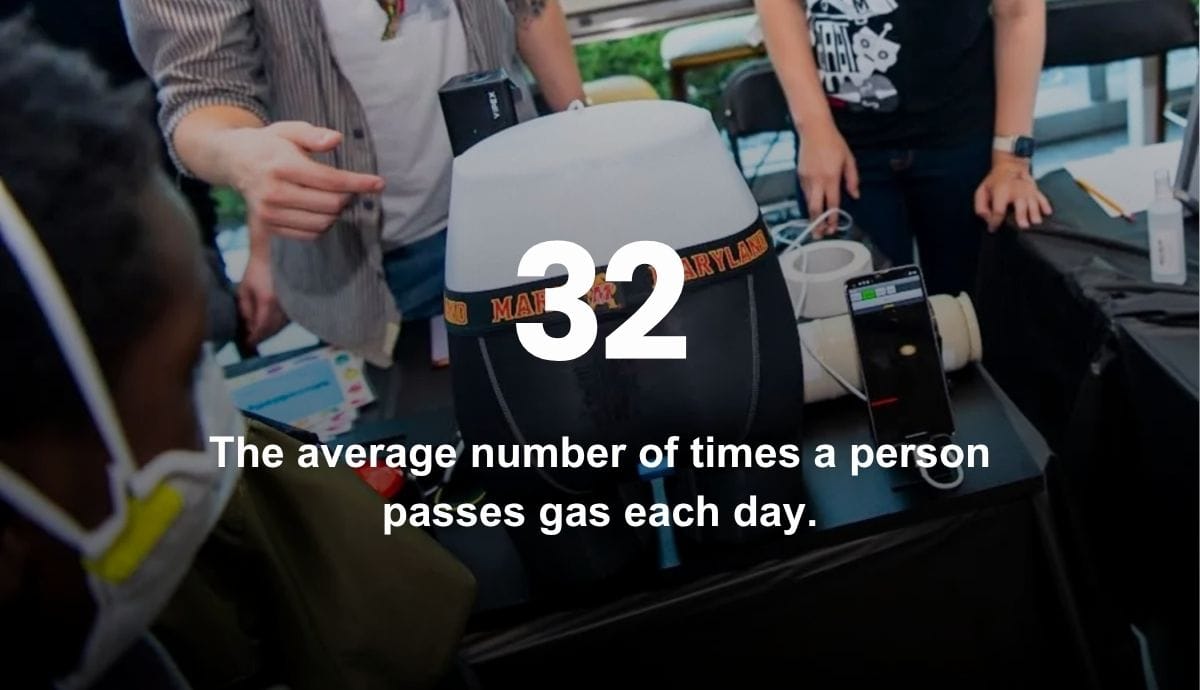
Researchers at the University of Maryland recently launched the Human Flatus Atlas, a nationwide research project aimed at discovering the typical range for daily human flatulence. To accurately track study participants’ wind production, the researchers developed Smart Underwear, the world’s first wearable device designed to measure human toots. The tiny device attaches to any underwear and uses electrochemical sensors to track flatulence around the clock (enrollment in the project is currently paused due to “overwhelming demand”).
WHY IT MATTERS
No accurate scientific baseline for flatulence exists, unlike blood glucose, cholesterol, and countless other physiological measures that have accepted normal ranges (experts say it’s currently virtually impossible for physicians to objectively measure patients’ flatulence, since tracking relies on self-reporting and doesn’t address passing gas while sleeping). Without an established baseline, physicians don’t actually know what a normal flatulence pattern looks like, making it hard to know when someone’s gas production is truly excessive. A small preliminary study by the researchers found adults pass gas an average of 32 times a day, double the figure (14 per day) that’s commonly reported in medical literature. The study also found individual variation was extreme, with daily totals ranging from as few as 4 toots to as many as 59.
CONNECT THE DOTS
Scientifically, the gas inside your intestinal system is called flatus, while the act of expelling that gas through your rectum is called flatulence. Most people’s flatus is made of hydrogen, carbon dioxide, and nitrogen (though some individuals’ flatus also contains methane). The researchers designed their Smart Underwear to specifically measure hydrogen, as it’s exclusively produced by gut microbes and tracking it provides a “direct readout” of when and how actively a person’s gut microbiome is breaking down foods.