- Sunrise Stat
- Posts
- 🌅 A New Branch of the Animal Kingdom
🌅 A New Branch of the Animal Kingdom

Sunrise Stat
January 26, 2026
Matt Humpage
Uncover the power of a single statistic: Sign up for Sunrise Stat to find your intellectual clarity.
SOURCE
WHAT TO KNOW
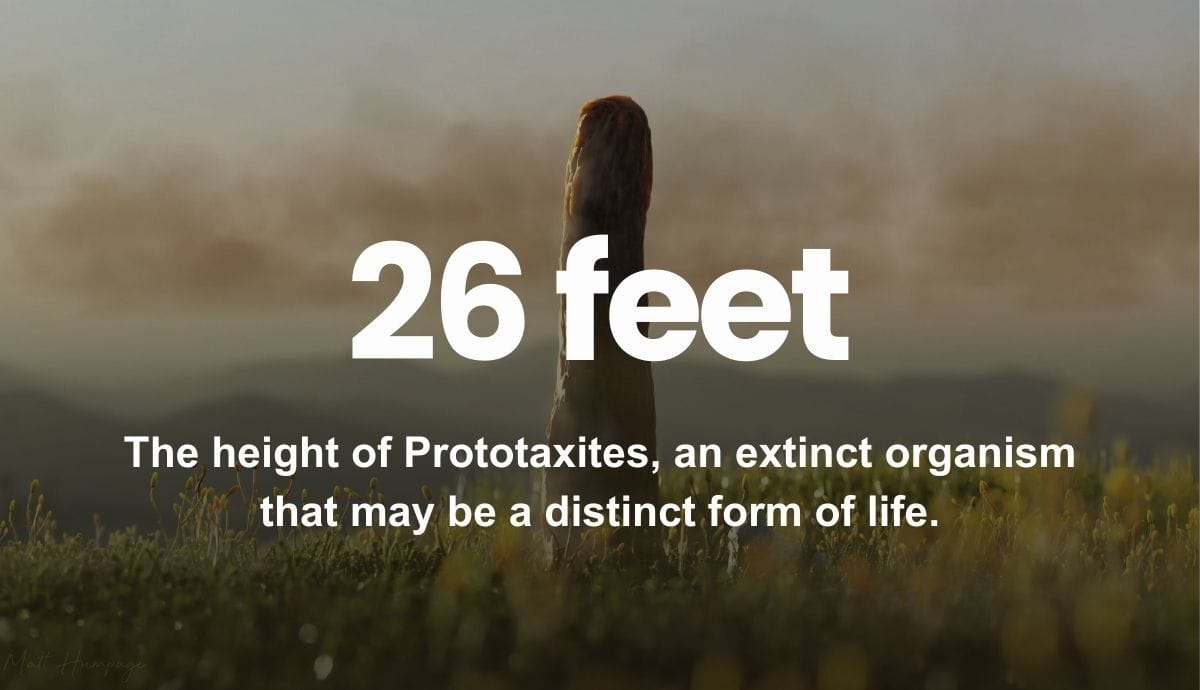
A new study by researchers at the University of Edinburgh in Scotland suggests Prototaxites, an ancient organism resembling a cactus with no arms, are a distinct and previously unknown form of life. Prototaxites were massive organisms—reaching up to 26 feet tall and 3 feet wide—that lived during the Devonian period around 420 million years ago. Before trees came along, they were the largest land-dwelling organisms on Earth.
WHY IT MATTERS
The first Prototaxites fossils were uncovered in 1843, however, until now, scientists weren’t able to determine whether the now-exinct organisms were a type of plant or fungus (the leading theory suggested they were a giant ancient fungus). The authors of the present study examined a Prototaxites fossil from the 407-million-year-old Rhynie chert (a sedimentary deposit in northeast Scotland), finding the organisms are anatomically and chemically distinct from plants and fungi, placing them in their own category.
CONNECT THE DOTS
Life on Earth is classified within three domains: bacteria, archaea, and eukarya. Bacteria and archaea contain only single-celled organisms, while eukarya contains all multicellular organisms within the four kingdoms of life: fungi, animals, plants, and protists. The present study suggests Prototaxites are a distinct form of life within the eukarya domain.